How foundations defend democracy in polarized times, open spaces for curiosity, and strengthen social cohesion. A review from Hamburg.
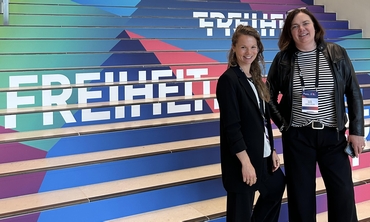
Last week, from May 20–21, 2026, the foundation sector gathered in Hamburg for the German Foundation Congress (Deutscher Stiftungstag), Europe’s largest congress of its kind, held under the motto “Acting out of Freedom” (Aus Freiheit handeln). Against the backdrop of global crises and an increasingly polarized society, one central question emerged – one that deeply moves us at the CONTRACT Stiftung and our partner organizations: What role do we play in these turbulent times? All of us who care deeply about people, relationships, and a strong sense of community?
The answer from the congress, echoing through numerous presentations and discussions, is clear: We need to become louder, we need to become bolder – and we need to create spaces for real, analog dialogue.
A Deeply Emotional Opening: Voices for Freedom
The opening event already sent a powerful message. Three voices from different contexts of anti-democratic structures took the stage: one voice from Iran, one from Turkey, and a school student from Germany who shared her experience of discussing the right-wing populist party AfD with her own grandfather. As the speaker from Iran shared her story, a profound emotional wave filled the room, culminating in a standing ovation from the entire auditorium. It was a moment that painfully, yet hopefully, reminded everyone present how precious our democratic freedoms are and how vital they are to defend.
Media, Trust, and Defending Democracy
In the subsequent panel discussion with Giovanni di Lorenzo (Editor-in-Chief of Die ZEIT), it became evident just how closely journalism and the foundation sector are linked in their social responsibility. Both thrive on their greatest asset: credibility. Di Lorenzo did not shy away from self-criticism regarding traditional media, noting that during crises, they have often operated too much within their own bubbles and lost sight of the perspectives of many everyday citizens.
For foundations, this translates into a clear mandate: In times when diversity is often perceived as a threat, we must withstand this diversity and act as platforms for respectful, democratic debate. Freedom is not a static condition; it is an action. Every single individual can make an important contribution to this by entering into real dialogue—even when it gets uncomfortable. For us, taking a clear stance is a matter of course.
Deepfakes and the Retreat of Civil Society
Dr. Eckart von Hirschhausen highlighted just how threatened this freedom is in the digital sphere during a presentation that was as unsettling as it was inspiring. Deepfakes and targeted digital hate are causing civil society to increasingly retreat out of fear of becoming targets themselves. Tech corporations consciously accept this climate of uncertainty for profit. When no one knows what is real and what is fake, the very foundation of our freedom of expression erodes. Fittingly, Katrin Vernau (Director-General of WDR/ARD) emphasized that genuine opinion-forming must be based on actively developing an informed perspective, rather than blindly believing unverified content.
The Penguin Metaphor: Why We Must Huddle Together
Hirschhausen’s most powerful takeaway was a plea for the analog: What we need now are real, human-to-human encounters—the ability to look each other in the eye. He used the metaphor of penguins, who can only survive freezing temperatures by huddling tightly together. It is not about who stands in the front row, but about taking turns and standing up for one another. This sentiment was also reflected during the evening at the informal reception hosted by ZEIT-Verlag (which included an impressive visit to the historic office of Helmut Schmidt): We must move closer together to actively shape these times and make the democratic majority visible once again.
Curiosity as a Democratic Virtue: The “Wunderkammer” Example
The session “Creating Free Spaces Together” by the Wunderkammer from Hamburg demonstrated that this shift must begin with the youngest members of society. This project is, in our opinion, a fantastic collaboration between a museum and a foundation. The Wunderkammer (Chamber of Wonders) radically designs its exhibitions from a child’s perspective and, through its mobile “Wanderkammer,” is also accessible to schools that cannot visit due to distance.
Here, it is not about providing ready-made answers, but about offering sparks that preserve natural curiosity. By philosophizing about objects together, children learn critical, analytical thinking. The beautiful phrase “Thinking is tidying up” particularly resonated with us. This is an important reminder for adults as well: In a world where seemingly everything is predetermined and strictly scheduled, we need more free spaces to think freely again.
Conclusion
The German Foundation Congress has shown that we all share the collective task of building bridges. Let us act together, open up spaces for dialogue, and keep curiosity alive just like the penguins: strong together and deeply connected.
Theresa Pfleghar & Katrin Saacke
